
Clear Retainer vs Fixed Wire: Which Orthodontic Retainer Is Right for You?

Which Orthodontic Retainer Is Right
Both clear retainer trays and fixed wire retainers can protect your orthodontic result; the “best” choice depends on your teeth, habits, and how much responsibility you want day to day.
How clear retainer trays work
Clear retainers (often called Essix retainers) are thin, transparent plastic trays that fit snugly over your teeth, similar to clear aligners. They hold each tooth in place by fully covering the biting surfaces and sides, spreading gentle pressure across the whole arch. Because they are removable, you take them out to eat, drink anything except water, and brush and floss.
From an ortho‑expert perspective, clear trays are excellent at controlling not just tooth position but also minor rotations and vertical changes, because the plastic “cups” the teeth completely. They are also relatively easy to replace or remake from a digital scan if they crack or are lost.
How fixed wire (lingual) retainers work
A fixed retainer is a thin metal wire bonded to the inside (lingual side) of your front teeth with small dots of composite material. It usually spans canine‑to‑canine on the lower teeth and sometimes on the upper, depending on your case. Once placed, it works 24/7 without you needing to remember to put anything in.
Clinically, bonded wires are especially useful in areas with a high risk of relapse, like lower front teeth that were crowded or rotated before treatment. The wire acts like a permanent anchor, limiting the natural tendency of those teeth to overlap again over time.
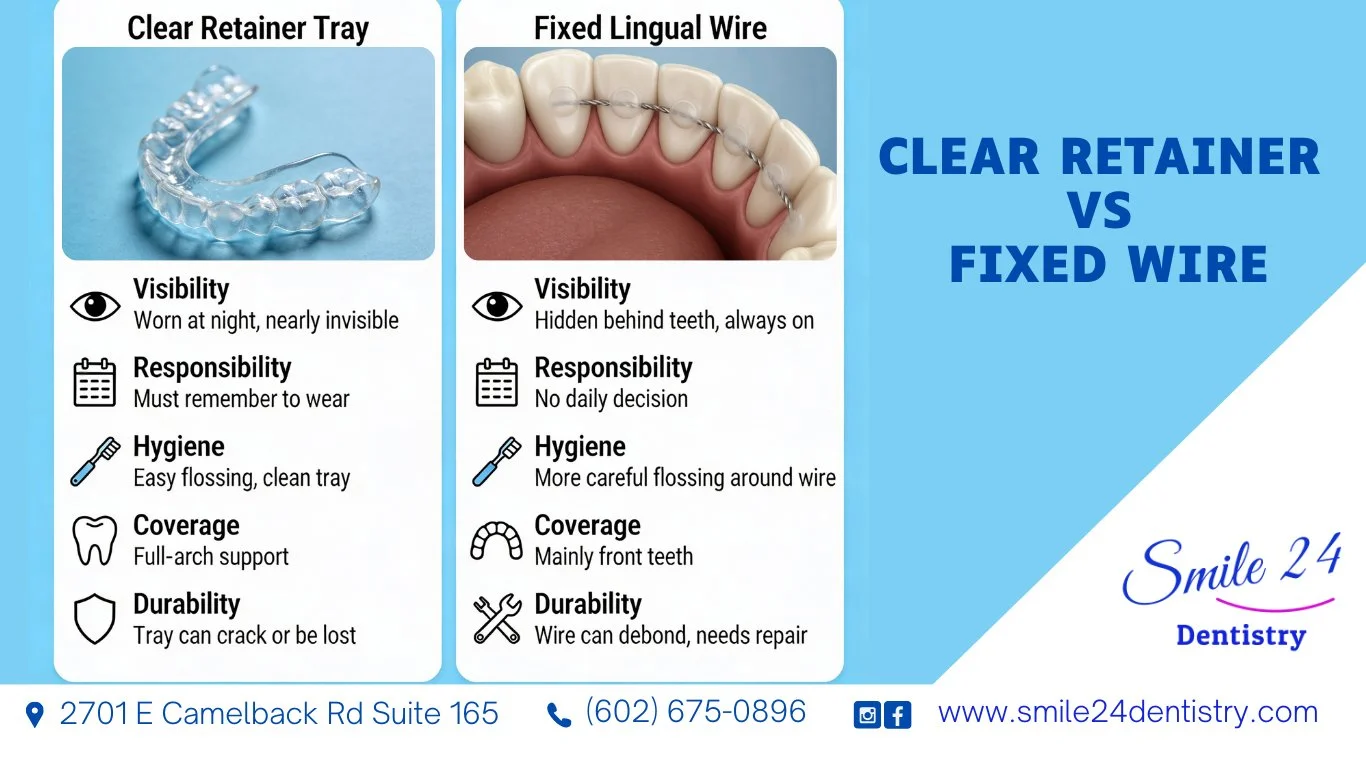
Comparison of Clear Retainer vs Fixed Wire
Orthodontists do not pick retainers randomly; they weigh the biology of your teeth and your personality. If your lower front teeth were very crowded or rotated, a bonded lingual wire is often recommended to “lock in” that alignment long term. For patients who admit they are forgetful or travel constantly, a fixed retainer gives baseline protection even if a removable tray is sometimes skipped.
On the other hand, if your gums are prone to inflammation or you have a history of plaque build‑up, a clear retainer might be safer because you can fully clean every tooth once it is out. Patients with strong nighttime clenching or a history of grinding may also benefit from a clear tray, which can double as a protective nightguard in some cases (if designed that way by the orthodontist). Often, specialists combine both: a fixed wire on the most unstable teeth plus a night‑time clear retainer over everything for added security.
Pros and cons of clear trays vs fixed wire
Clear retainer trays
Pros
Aesthetic: virtually invisible, especially if you mostly wear them at night.
Hygiene‑friendly: you can brush and floss normally, then clean the tray separately.
Full‑arch control: can stabilize many teeth at once and help manage bite contacts.
Cons
Compliance‑dependent: if you forget or stop wearing it, relapse can start quickly.
Fragile: can crack or warp, and clear plastic dislikes hot water and heat.
Easy to lose: wrapped in a napkin at a restaurant or left where pets can chew it.
Fixed lingual wire retainers
Pros
Always working: no daily decision or routine needed to keep it in place.
Excellent for high‑risk areas: particularly strong at preventing lower incisor crowding.
Invisible in photos and daily life because it sits behind the teeth.
Cons
Trickier cleaning: plaque can build up around the wire if flossing is rushed.
Breakage risk: if a bonding point comes loose, teeth can start to shift before you notice.
Not ideal for patients with poor oral hygiene or high decay risk, unless they are very motivated.
How to decide what is right for you
The best question is not “Which retainer is perfect?” but “Which retainer will you actually live with for years?”. If you are conscientious, like routine, and want the freedom to have nothing on your teeth during the day, a clear retainer is often an excellent first choice. If you know you tend to forget or had severe crowding - especially in the lower front - you may be safer with a fixed wire, sometimes backed up by a nighttime tray.
Many adults do best with a combination: a bonded lower retainer to guard the most unstable teeth plus a clear upper (and sometimes lower) tray worn at night for global support. The most caring choice is the one made together with your orthodontist after an honest talk about your habits, gum health, and how you see yourself maintaining your new smile ten or twenty years from now.